
Resolution 1 2025

RESOLUTION BY THE TRUSTEES OF THE PADDOCKS BODY CORPORATE

RE: APPROVAL OF SECTION EXTENSION AT THE SOUTHERN SIDE OF UNIT 10

  1. RESOLUTION NUMBER: 1 / 2025
  2. DATE:23 June 2025

BACKGROUND

The Trustees of the Paddocks Body Corporate have received and considered an application for a section extension at the southern side of Unit 10, in accordance with the provisions of the Sectional Titles Act 95 of 1986 (“the ST Act”). (Linked)

ARCHITECTURAL SUBMISSION

The Trustees acknowledge receipt of the architectural submission prepared by Jacqueline le Roux Architects, detailing the proposed extension to the boundaries and floor area of the section above. (Linked)

LEGAL COMPLIANCE

The Trustees note that the following legal requirements and procedural steps have been addressed:

Municipal Building Plan Approval: The architect, Jacqueline le Roux, has submitted the building plans securing municipal building plan approval in compliance with Section 4(1) of the National Building Regulations and Building Standards Act 103 of 1977 and Section 3(1)(p) of the Sectional Titles Schemes Management Act. The architect is a registered professional with the South African Council for the Architectural Profession (SACAP).

Insurance Amendment: Our broker, Rickus Schoeman at Schoeman Makelaars did a property evaluation and submitted it to our managing agent.

Levy Calculation & Participation Quota Assessment: The Managing Agent, Gerda de Clerck, will calculate the revised liability for levies based on the adjusted participation quota following completion of the extension. The proposed extension will result in an alteration to the participation quota (PQ) of the extending section and consequently affect the PQs of all sections within the scheme. The Trustees note that the extension represents less than ten per cent of the existing square meters, thereby eliminating the requirement for consent from all unit bondholders as stipulated in Section 24(6A) of the Sectional Titles Act. (architectural drawing attached)

Registration Requirements: The conveyance attorney, Michal Müller at Breytenbach Mavuso, will proceed with registering the approved amending sectional plan of extension at the Deeds Registry and obtaining a new title deed for the extended section in accordance with Section 24(4) of the Sectional Titles Act.

COMPLIANCE WITH CONDITIONS

The Trustees are satisfied that the proposed extension meets all conditions regarding the use and appearance of the structure and building improvement as required by the scheme’s rules and regulations.

RESOLUTION

Therefore, be it resolved that the Trustees of the Paddocks Body Corporate hereby approve the completed section extension at the southern side of Unit 10, noting that construction is to be finalised, subject to:

Diligent pursuit of all outstanding municipal approvals and compliance with building regulations, acknowledging that municipal processing timeframes are beyond the control of the body corporate and section owner;

  • Registration of the amending sectional plan at the Deeds Registry;
  • Amendment of the section owner’s insurance policy to reflect the extended unit;
  • Payment of all associated costs and fees by the section owner; and
  • Continued compliance with all body corporate rules and regulations.

EFFECTIVE DATE

This resolution takes effect immediately, with the understanding that all outstanding legal and administrative requirements must be diligently pursued, recognising that municipal approval timeframes may extend significantly due to administrative backlogs beyond the parties’ control.

TRUSTEES OF THE PADDOCKS BODY CORPORATE

This resolution has been passed in accordance with the provisions of the Sectional Titles Act 95 of 1986 and the Sectional Titles Schemes Management Act 8 of 2011.

Common property v exclusive use area

Are we entitled to exclusive-use areas?

In answer to this question, that’s recently been asked frequently 

What is a sectional title?
A title system in which ‘sections’ of buildings are created for separate ownership. A ‘sectional plan’ is registered and available at the Surveyor-General’s Office for each sectional title development. All the parts of the land and the buildings that are not labelled as sections (or parts of sections) on the sectional plan are ‘common property’.The common property is owned jointly by all the people who own sections. The sectional plan for a scheme may also show ‘exclusive use areas’. These are defined parts of the common proper set aside for ‘exclusive use’ by particular owners, for example, as a garden area or parking bay. The entire development is referred to as a sectional title ‘scheme’.

What is sectional title ownership?
It is ownership registered at the Deeds Registry. The Deeds Registry records ownership of ‘units’ in a scheme. Each unit is a particular section, which could be a flat or a garage, and a share in the common property. The Deeds Registry records also show any registered ‘exclusive use rights’.

What is common property?
The common property in a scheme is those parts of the land and buildings that are not contained within any section according to the registered sectional plan. For example, the common property usually includes all the land, the foundations, roofs, passages, parking bays, lifts, garden areas, swimming pool and any other facilities.

What is an exclusive-use area?
An exclusive use area is a defined part of the common property set aside for exclusive use by a particular owner. You may buy and become entitled to ‘exclusive use rights’ that allow you the sole rights to use a part of the common property, such as a parking bay, carport or garden area.

In addition to a unit, an owner may hold rights to the exclusive use of a portion of the scheme’s common property. 

EUA may be shown on the registered sectional plan or a plan that forms part of the scheme’s rules. 

EUA rights are commonly granted for parking bays, gardens, balconies, garages


Big changes for complexes

A recently issued Practice Directive from the Community Schemes Ombud Service (CSOS), officially signed and published on 18 July 2025, establishes comprehensive guidelines for community schemes regarding various matters, including pet policies, penalty procedures, and domestic worker regulations. This new CSOS Practice Directive replaces all previously issued documents on these topics and now functions as the definitive reference guide for trustees, managing agents, and other relevant parties involved in community scheme governance.

FY2026 Tarrifs

Eskom tariffs to be implemented in 2025 are adjusted with the annual increase and updates to the tariff structures as approved by the National Energy Regulator of South Africa (NERSA) on 11 March 2025. The FY2025 tariffs are adjusted with a 12.74% annual average increase

Eskom direct customers tariffs will increase by 12.74% effective on 1 April 2025.

Time of use tariffs

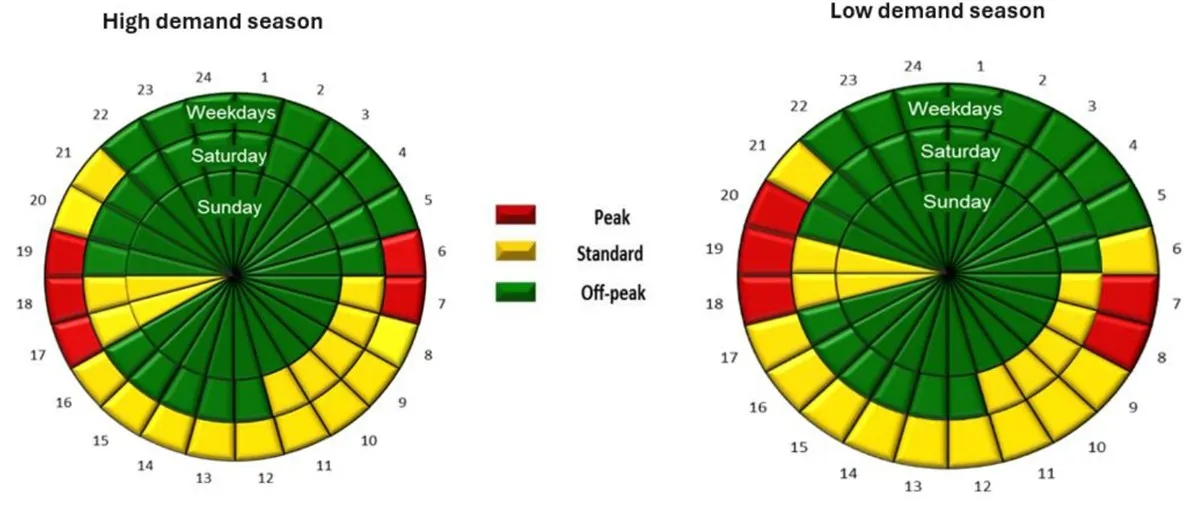
The ratios, prices, and periods were adjusted better to align the time-of-use signals to the National System Operator whilst meeting industry, mining and commerce needs. The ratio, off-peak high-demand to off-peak low-demand ratio, reduced from 8:1 to 6:1. Evening peak hours increased from 2 to 3 hours whilst morning peak hours were reduced from 3 to 2 hours. A new 2-hour standard period on Sunday evenings was introduced.

Residential tariffs

The tariffs no longer have an inclining block structure (IBT). Homelight tariffs have a single c/kWh rate. Home power tariffs are unbundled into separate cost-reflective energy, network, and retail (service and administration) charges.

From 1 April, the revised times of the peak, standard and off-peak periods for weekdays, Saturdays and Sundays in the high-demand winter season (June, July and August), and the low-demand summer season (comprising the remaining months of the year), are shown below:

Going Solar

Maximizing Solar Panel Efficiency: Key Considerations

Optimal Placement
Solar panels produce the most power when they face directly toward the sun. In South Africa, most residential solar systems are mounted on north-facing rooftops to maximize sunlight exposure. When evaluating your solar installation site, ensure it provides direct sun exposure by checking for potential obstructions like trees, chimneys, or other structures that could cast shade.

Shade Management
While photovoltaic (PV) optimizers and microinverters can improve performance in moderate shade, excessive shading will significantly reduce system output. Keep in mind that shadows lengthen during winter months, so even if your panels receive adequate sun in summer, winter shadows may impact performance.

Understanding Sun Hours
“Sun hours” refer to the time during which sunlight is strong enough to generate 1,000 watts per square meter. On average, locations receive 4–6 usable sun hours daily. The more sun hours your area gets, the fewer panels you’ll need to achieve your energy goals.

Determining System Size
The number of panels required depends on:

  1. Panel Efficiency – How effectively each panel converts sunlight into energy.
  2. Energy Goals – Your desired power output.
  3. Budget – The amount you’re willing to invest. See quotes

Grounding and Safety
Proper grounding of metal and electrically conductive materials is crucial to avoid electrocution and fire risks. Follow these key grounding guidelines:

  • Ground solar racking according to the manufacturer’s instructions.
  • Use permanent crimps for splices in grounding conductors, avoiding wire nuts.
  • Connect the equipment grounding conductor (EGC) to the grounding busbar and extend it to the ground rod if possible.

Roof Condition and Longevity
Solar power systems are built to last over 25 years. Before installation, assess whether your roof is structurally sound to support the solar array throughout its lifespan.

Sizing Your Solar and Battery System

To properly size a solar and battery system, follow this formula:
Annual usage + 20% buffer = Daily usage x (70% for batteries + 30% for daytime use)

Imagine a house using 10,000 kWh of energy per year. Here’s how to calculate the solar and battery requirements:

  1. Add a Safety Buffer
    Account for unexpected energy consumption growth and system inefficiencies by adding a 20% buffer to your annual usage. This increases the total to 12,000 kWh.

  2. Calculate Daily Usage
    Divide the adjusted annual usage (12,000 kWh) by 365 days to determine daily energy needs. This gives an average of 32 kWh per day.

  3. Understand Energy Patterns
    Since most energy is consumed during peak hours (4 PM to 9 PM), estimate that 70% of daily energy (23 kWh) will need to come from batteries for evening and nighttime use.

  4. Determine Solar Panel Requirements
    To cover the total daily energy needs (32 kWh) and charge the batteries, size the solar array accordingly. With 5.5 sun hours per day, a 6 kW AC system should suffice. This system generates about 32 kWh daily (6 kW x 5.5 hours).

  5. Choose Battery Capacity
    Opt for a battery bank that can store around 23 kWh of energy, ensuring sufficient power for non-solar hours and peak consumption times.